hey, thanks so much! this might get a lil long (as it always does!!) so bear with me.
firstly i want to say, there’s no right or wrong way to pick colors. every artist has their own palette they prefer and i think it’s super delightful to spend time developing your own special sense of color. so even though i’m explaining things in a “this is how you do it” sort of way, it’s not the only way! just my way. the best method to develop your own sense of color is to look at a LOT of art, look at a LOT of the world around you, and practice practice pratice.
at this point in my life i pick colors intuitively just because i think it’s something i’m naturally tuned into, and i’ve been doing it for a few years, so i don’t actively plan my palettes. but here are some things that i think about as i pick colors.
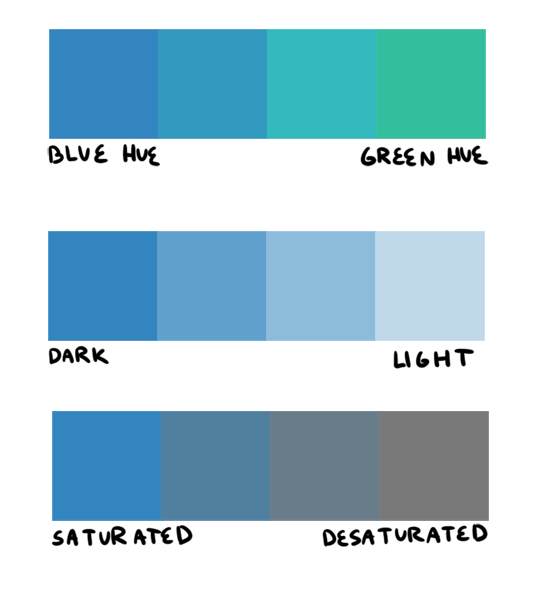
firstly, i want to go over hue, value, and saturation. i’m sure everyone knows these intuitively but i want to explain them in words. hue, value and saturation are what make up a color, and decide how colors differ from each other.
hue: what color the color actually is. red, purple, green, yellow, and everything in between.
value: how light or dark a color is. if you’re painting traditionally, adding more white or more black to a color lowers or raises its value.
saturation: how “pure” the color is vs how much neutral tone is in it.
here’s an example of all three:
this comes into play because a big mistake i see beginners make is that they pick a “just” color, and by that i mean they pick “just blue” or “just yellow”. imagine buying a set of oil paints and only using paints straight from the tube without ever mixing. it would be impossible! so i try to avoid picking “just” colors, except as for a complementary color (more on that in a bit). here are some variations of a red, for example.
so, the biggest thing for me when i pick colors is that i want them all to be friends. i want them all to have something in common so that they get along. i usually lose control of a painting when my colors feel to different from one another. so, i will usually start a painting with one color i know for sure i want, and “subordinate” other colors to it, meaning every other color i pick has to look good with that color. as to how you figure out what looks good and what doesn’t, that just takes time and lots of observation to build a personal opinion 🙂 here’s an example from one of my paintings. in this case, the main color is the trees.
and here’s another from rick & morty, the main color is the sky this time.
now that that’s out of the way, i’m going to give you the Actual Cheat Sheet for color palettes. in color theory, there are 8 basic color schemes that are generally pleasing to look at. here they are.
i usually use an analogous palette or monochrome palette out of preference. the two examples above more or less fall into those categories. however, i also like to use split complementary because the complimentary color adds a LOT of contrast and visual interest. it’s great to use if you have a specific thing in a painting you want to draw attention to. here’s an example:
it doesn’t always have to be a perfect split complementary, just one color that differs from the “family” of colors that take up a majority of the piece.
now! you might be wondering when’s the right time to subordinate a color, or where to put it, or how much of it to use, etc. and the answer is: CONTRAST. there is always visual interest in things that are different. i was rifling through my school notes and found these great types of contrast when working with color.
value: things that are light vs things that are dark.
hue: two colors that look different. I.E. yellow vs blue.
saturation: things that are saturated vs things that are desaturated.
proportion: note the example above. a majority of the painting is orange, so the green stands out because there is proportionally less of it.
temperature: things that are warm vs things that are cool.
complementary: red vs green, blue vs orange, yellow vs purple. when in doubt, these colors always contrast against each other because they have nothing in common (there is no red in green, etc).
simultaneous: this is a little advanced and i’m bad at explaining it, so please read up on it here.
a super helpful exercise is to look at your favorite illustrations, paintings, photographs, designs, etc and assess which one of the 8 color schemes (linked above) it has, and which types (can be more than one) of contrast it has. we did this in school and it REALLY helped me look at color better. here’s part of the assignment i did, the artist is annette marnat.
so! that’s pretty much how i think about color and how i pick my colors! i hope it was somewhat helpful! there’s so so so so much about color theory i can’t even begin to cover, i highly urge you to watch some videos and read some books and articles to further your study. a great starting place would be this series of videos. these are made by my teacher Richard Keyes, i think he had a dvd or something. everything i’ve talked about so far i learned from him and he is an absolute expert in color. these videos are invaluable. if you take anything away from this post, let it be to watch these videos hahaha.
to answer your question about my color leads, every painting was a collaborative effort between the three of us, and sometimes other painters too. it was a very hands-on crew, so i can’t say any of the r&m bgs i did are 100% “mine”. however, i think my personal color sense is waaaay different than jason or phil’s, which made the process very interesting because we usually had 3 very different opinions hahaa. you can check out their work here and here to see what things they brought to the table in relation to my own contributions.
thank you for the ask! again, i hope this was helpful 🙂
I don’t, but I can put something together right here. All the links below contain the information about them and what you’re looking for. Though some topics are a little more difficult to find sources on. If there’s something that you really want to know, than I suggest contacting an actual Native American, specifically a Mohawk to ask.
They do have official websites and places such as a museum and communities that you can ask. Even on Tumblr, you may be able to find someone to discuss it with (via Diversity Cross Check). If not, there’s Reddit: Native American (Reddit: Indian Country – By Native, About Natives & The Americas) and many Native American authors that are open to educating and/or assisting you to write accurate, non-stereotypical and non-colonialist mindset portrayal of Native American characters.
So here you have everything I have related to Swedish. Most stuff I’ve found online (especially books and, of course, websites). The documents on Mega are from the lovely @lovelybluepanda.
I’m probably forgetting some stuff, and I’ll update this when I have new stuff to share. Please, let me know if any of the links doesn’t work!
When you guys have visited potential apartments, what kind of questions did you ask besides the basics like what rent and utilities include?
Here are questions I didn’t ask but should have: what does the basement look like?
What measures are taken to secure the building ?
Are the walls thin? Brief info of who lives in the building. Are they college kids? People that work through the day? Elderly? Is it a mix? Where does the garbage go?
Can I pay rent bi-weekly? What kind of fuses does the apartment use? (My fuse box is in the basement. If I blow a fuse I have to replace it myself. They screw until the box. All of which I didn’t know until it happend and I was sitting in the dark suddenly)
Who do I call for repairs? (If it’s a private rental) Am I allowed to paint the walls? Is there any additional storage? Do you do regular pest control?
count the outlets, ask about recycling policies, ask if there’s a noise restriction (nothing loud after midnight, everything goes on the weekend, etc)
LAUNDRY FACILITIES Definitely ask about security Whether subletting is allowed (esp if you’re in college and might want to sublet for the summer) If you have a car, whether there’s parking/how much it costs What kind of heating/AC there is Procedure/response time for any maintenance How mail/packages are received/protected from theft (seriously people stealing your packages can be a huge problem) What kind of verification of your salary will they want, and in what circumstances will they accept a guarantor instead? Whether the apartment is furnished
Assuming you are in the middle of looking at/choosing between places: When does the lease start? Are you going to give preference to people based on when they can move in? Whether groups of a certain number of people get preference Really anything about who they prioritize for applications, it can save you a lot of trouble in trying to apply to places you’ll never get into
not something for asking the realtors, necessarily, but important rights you should be aware of as a tenant:
when and for what reasons are your landlords allowed to enter your home? how much of a notice should they give you before entering?
can the landlord make modifications to your home or apartment without your approval? to what extent?
what are the options and conditions for breaking your lease early if there’s an emergency? (this is ESPECIALLY important for anyone moving to a new state/considerable distance where you are not able to visit the apartment/home before you rent – students get taken advantage of ALL THE TIME with this shit)
if your first or last month at the property is a partial stay (i.e. you move in on july 15th, and rent is typically due on the first) make sure you don’t pay the full first month’s rent before you know the area laws! in many states, you are only legally required to pay for the time you are occupying the property
is renter’s insurance necessary? many apartments want at least 30k coverage, which can run a couple hundred dollars extra per year
are the landlords/property management liable for crimes on the property? for example, if your car was broken into. if not GET RENTER’S INSURANCE
-ask if there’s any property upkeep you can do to get a bit off the rent (aka, can they take 100$ off the monthly rent if you maintain the lawns/garden, etc.)
-ask if there’s been any consistent/frequent trouble with electricity/internet connectivity/cable if you have it
-what KIND of electricity?
-what kind of heating (hot water/electric)
-how secure is the neighborhood (if you don’t know)
-ANY PLUMBING ISSUES? check ALL the fucking taps, the showers, EVERYTHING WITH WATER to make sure it all works right.
-ANY PLUMBING ISSUES? check ALL the fucking taps, the showers, EVERYTHING WITH WATER to make sure it all works right.
I CANNOT SECOND THIS ENOUGH.
ALSO
– who last lived here? why did they leave?
– Do they charge an “amenities fee” (Around here you can’t avoid them at all now, but some places you might still be able to)
– Do they have a policy on rent increases? (Also check if there’s a legal limit to rent increases in the area).
– Are utilities paid in a separate check or with the rent?
– Are utilities metered or pro-rated (in older buildings it’s common to be charged by square footage and/or number of occupants, which can leave you subsidizing the people who turn the a/c down to 60 in the summer or the heat up to 80 in the winter – you may not be able to avoid this but it’s worth trying).
– Are there any switched circuits in the apartment. Buildings built in the late sixties through the early eighties often have switched circuits. If they do, then with the number of devices used these days you will probably have to have something important on the switched circuit – tape the switch in the on position! (Trust me).
– What are the rules on hanging pictures?
– Who is responsible for paying for and replacing bulbs in permanent fixtures? If it’s you and there’s a fixture with weird/unusual bulbs (globe style, chandelier style, etc) ask where you can buy the bulbs.
– What are the rules about pets? Do they have breed specific restrictions on dogs? Size restrictions on fish tanks? (Believe it or not that’s not uncommon).
This will be so useful once my lease is up thanks tumblr ☺️🙏🏾
z̗̟̻̫̼͓͂ã̤̬͓̼͓̔̐̇͑ͩ̀l̯̜̰͐̒ͪg̺͎͈̍o͍̫̬̤ͭ ͍ͩͤ̈́a͇̘͙̼̠̪̣ͨ̾̍̿k̼ͣa̯̮͇̟ͫ̑ͤͭ̔̊ͣͅ ͌͆s̮̫̼͖̫̖̐̆ͦc̎ͪÃ͔̬̘̫̣̮̮̂̉͗R̈́Ẏ̖͕͚̱̩̠ ̫̝͎̞͖̄T͔̎͊̍ͪ̔E̲̞̽ͨ̿̑X͓̜̩̖̜ͦ͊T̹̥̰̊̎͂ found here
here and here for ƒαηcу/սռﻨƈօժε †εχ† (☞ here for unicode symbols ☜)
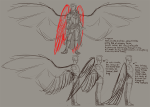
In which Amanda has too many thoughts about a celestial AU, but, gosh darn it, she loves the sketches too much to let the embarrassment totally override posting them and sharing her transformation thoughts.
I do need to take out some anatomy books to really get the back working how I want. I want it to be very obvious that his entire back structure changes to accommodate those wings. Unfortunately, I always do these sketches at, like, 4am, which is not a time I want to research bird wing and human back and shoulder anatomy at.
(And I totally didn’t write it on the sheet, but until the feathers grow completely in, he’s basically oozing this black oil-like fluid. It coats the feathers and just is a constant point of discomfort.)
EDIT // Added last sketch showing kind of what size I think the wings would be once they’ve finished being painful and awkward.
I’ve been asked many times what someone should look for when trying to find a good artist. The best way you can do this is to look at their portfolio, whether it’s in a book at their shop or online. If they don’t have good work in their portfolio, they’re probably not good artists.
The shop may be clean, the people there might be nice, and the design they draw up for you might be exactly what you want, but if your artist doesn’t stand up to the points listed above, then you’re going to get a bad tattoo.
It’s okay to walk into a shop, talk with an artist for a while, and decide you don’t want a tattoo from them. Even if the artist has a bad attitude about it or tries to convince you to just let them do it, remember this is going to be on your body for the rest of your life.
This is fucking fantastic thank you!!
So important. I had an apprentice tattoo me once without any supervision – wound up with a blurry tattoo, and a messed up tendon for a while after 😡




















 lav3nderwolftumblr
You must be logged in to post a comment.