hello! my first point would be that the verb åkar doesn’t exist, i think you mean åker? anyway, you use the regular form when you wan’t to say that you actually are doing something, or that something actually is happening. like
i am going – jag åker
i am – jag är
i study – jag studerar
you can never use the infinitive directly after the subject! you can use the infinitive after you use the regular form as in
i will go – jag kommer åka
i think about being – jag tänker på att vara
i will swim – jag kommer att simma
i love to sing – jag älskar att sjunga
i hate to complain – jag hatar att klaga
if you use the infinite directly after the subject it becomes the same as
So here’s my post on Swedish pronouns. I limited it to these two groups because I think they are most confusing. Please correct any mistakes and ask questions if you have any! I realize some translations might be somewhat awkward, the material I was using to do this was made for Croatian-speaking (my first language) learners of Swedish.
I might do some more posts on Swedish grammar/linguistics if anyone is interested, so fire away with suggestions.
INTERROGATIVE
Vilken, vilket, vilka + obestämd substantiv/fras = WHICH
Vilken stad besökte du? = Which city did you visit?
Vilkendera, vilketdera (+ bestämd substantiv) = WHICH OF THE TWO
Vilkendera av Storbritanniens prinser tycker du mera om? = Which (of the two) British prince do you like more?
Vem (sg. animate, pl. vilka) = WHO
Vem sa det? = Who (one person) said that?
Vilka gjorde det? = Who (more people) did that?
Vems (poss. form of vem, animate) = WHOSE
Vems jacka är det? = Whose jacket is this?
Vad för (en/ett, någon) = constructions meaning WHICH/WHAT
Vad talar du för språk? = Which languages do you speak?
Vad för några bloomor har du köpt? = What flowers did you buy?
Hurdan, hurdant, hurdana + bestämd substantiv = WHAT KIND/WHAT is sth/sb LIKE (answer is an adjective, not so commonly used)
Hurdant är vädret? = What is the weather like?
Hurudan är hon som talesperson? = What kind of a spokesperson is she?
Vad, vilken can be used in exclamative constructions in informal spoken language
Vilken fin rock har du köpt! = What a nice dress you have bought!
Vad vacker du är! = How pretty you are!
RELATIVE
Important to note here is while a nonrestrictive relative clause will always be separated by a comma, restrictive clauses, unlike in English, can be used both with commas and without.
Som vs. vilken, vilket, vilka
used to introduce relative clauses, both used for both animate and inanimate antecedents (som stays the same for both genders and plural)
som is preferred in normal speech, vilken/t/a is used in more formal speech or for stylistic reasons
Jag har en syster, som/vilken läser spanska. = i have a sister(,) who studies Spanish.
Böckerna(,) som/vilka jag har använt(,) står på bordet. = The books which I used are on the table.
if the relative clauses contains a preposition, both vilken and som can be used with the preposition at the end of the relative clause (in my experience, som will almost always be used in this case)
however, only vilken and not som can be preceded by the preposition
Jag har köpt boken, som/vilken du talat om. = I have bought the book which you talked about.
Pojken, om vilken vi talat igår, har kommit. = The boy about whom we talked yesterday has come.
relative pronoun can be omitted form the relative clause unless it is the subject
Pojken, som spelar piano, är min son. = The boy who is playing the piano is my son.
Pojken, (som) du ser, är min son. = The boy (whom) you see is my son.
Vilket can also be used as a sentential relative, where his antecedent is a phrase or a clause (in this case it can be replaced by något som)
Han gifte sig, vilket/något som förvånade mig. = He got married, which surprised me.
Vars vs. vilkens, vilkets, vilkas
used to introduce relative clauses with the meaning WHOSE, both for animate and inanimate antecedents
vars can be used for both genders, singular and plural
in singular vars is preferred, and vilkens/vilkets is considered formal
Bodil, vars (vilkens) föräldrar är skilda, är min bästa vän. = Bodil, whose parents are divorced, is my best friend.
Huset, vars (vilkets) ägare jag känner, brann ner.. = The house, (whose owner I know) the owner of which I know, burned down.
in plural Swedish speakers prefer using vilkas, although vars is also accceptable
Barnen, vilkas (vars) föräldrar jobbar mycket, kan vara ensama. = Children whose parents work a lot can be lonely.
Vad is used as a relative pronoun in the meaning ‘det som’ = WHAT
Jag vet vad han gjorde. = I know what he did.
when it is the subject of the relative clause, som has to be added
Vad som förvånar mig är… = What surprises me is…
I think this post is great and I think it’s very useful, though there are some things I want to point out.
When it comes to “som vs. vilken, vilket, vilka” I’d say that vilken/t/a is HIGHLY uncommon. I actually had to look it up because it sounds super unnatural to me (native Swedish speaker). I guess I could understand it being used for stylistic reasons, but I don’t know how formal you have to get to use it. I’ve never seen it in newspapers, in textbooks, in science magazines etc. I’d say it’s better to just use “som” at all times.
The thing with the “pojken, om vilken vi talat om igår, har kommit” phrase is not something you’d say. The most natural way to say it would be “pojken, som vi talade/pratade om igår, har kommit”. Vilken/t/a is not really used as an equivalent to “som”, rather only “vilket” is used as “which”, and also as a sentential relative as you mentioned. I’m not good with the grammatical terms for things so I apologise for not being super structured.
Also considering “vars vs. vilkens/vilkets/vilkas” I’d say that sticking to “vars” is the best. My phone even autocorrected “vilkets”. Even though it is technically correct to use the other plural forms, I’ve never really seen them and they sound awkward. It’s like you didn’t know “vars” existed and tried to figure it out on your own.
And then only some small spelling errors like “bloomor” instead of “blommor” and “ensama” instead of “ensamma”. Those were probably not intentional though!
Great post otherwise and I’d love to see more!
EDIT: I talked to my dad about the use of vilken/t/a and vilkens/vilkets/vilkas and he said that he uses them sometimes, though ONLY in written form. This is not something you use in speech. He also said that it’s mainly used for administrative purposes, like in his job. If you’re not in that field I’d suggest sticking to “som” and “vars” instead👍
IF IT HAS BEEN A VERY LONG DAY, YOU ARE ‘WEARY’. IF SOMEONE IS ACTING IN A WAY THAT MAKES YOU SUSPICIOUS, YOU ARE ‘WARY’.
ALL IN ‘DUE’ TIME, NOT ‘DO’ TIME
‘PER SE’ NOT ‘PER SAY’
THANK YOU
BREATHE – THE VERB FORM IN PRESENT TENSE
BREATH – THE NOUN FORM
THEY ARE NOT INTERCHANGEABLE
WANDER – TO WALK ABOUT AIMLESSLY
WONDER – TO THINK OF IN A DREAMLIKE AND/OR WISTFUL MANNER
THEY ARE NOT INTERCHANGEABLE (but one’s mind can wander)
DEFIANT – RESISTANT DEFINITE – CERTAIN
WANTON – DELIBERATE AND UNPROVOKED ACTION (ALSO AN ARCHAIC TERM FOR A PROMISCUOUS WOMAN)
WONTON – IT’S A DUMPLING THAT’S ALL IT IS IT’S A FUCKING DUMPLING
BAWL- TO SOB/CRY
BALL- A FUCKING BALL
YOU CANNOT “BALL” YOUR EYES OUT
AND FOR FUCK’S SAKE, IT’S NOT “SIKE”; IT’S “PSYCH”. AS IN “I PSYCHED YOU OUT”; BECAUSE YOU MOMENTARILY MADE SOMEONE BELIEVE SOMETHING THAT WASN’T TRUE.
THANK YOU.
*slams reblog*
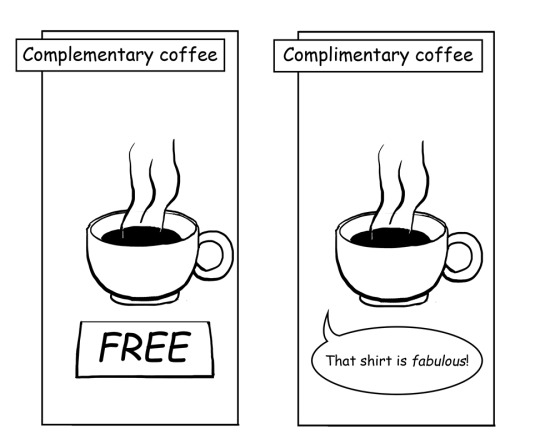
IT’S ‘MIGHT AS WELL’. ‘MIND AS WELL’ DOES NOT MAKE GRAMMATICAL SENSE.


 lav3nderwolftumblr